
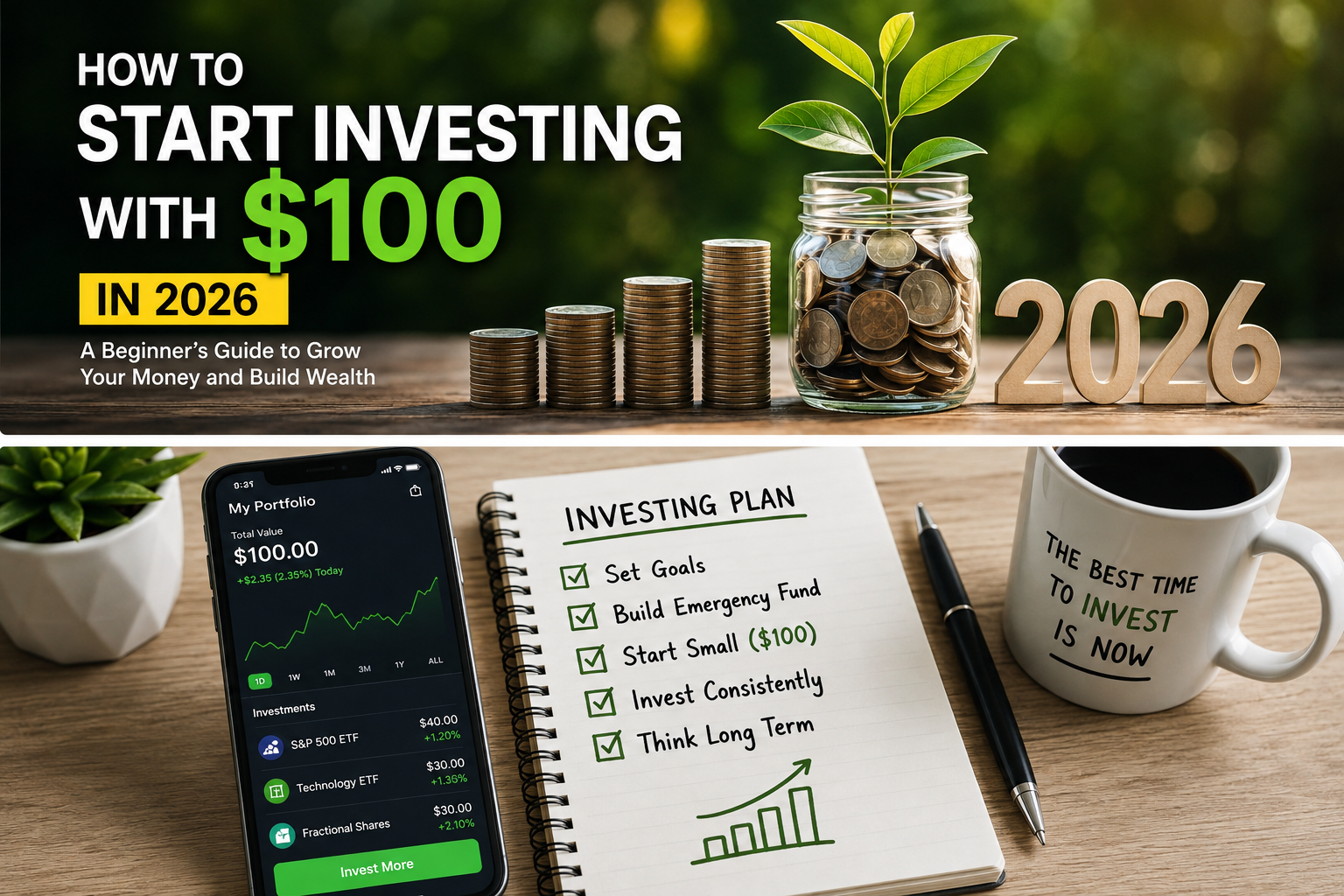
Think you need thousands of dollars to start investing? Think again. In 2026, modern investing platforms make it possible to begin with just $100.
Whether your goal is building long-term wealth, creating passive income, saving for retirement, or simply learning how the stock market works, starting small can be a smart first step.
The key isn’t having a large amount of money. It’s choosing suitable investments, keeping fees low, managing risk, and investing consistently over time.
[Insert Image 1 – Hero Image]
Alt Text: How to start investing with $100 in 2026
Why Start Investing With $100?
Starting with $100 may seem insignificant, but the real value is developing a consistent investing habit.
When you invest a small amount, you can learn how markets work without putting a large amount of capital at risk. You also begin understanding important concepts such as diversification, compound growth, investment fees, market volatility, and risk tolerance.
The earlier you start, the more time your money potentially has to grow.
However, remember that investments can lose value. There are no guaranteed stock-market returns, so you should only invest money that fits your financial situation and goals.
Best Ways to Invest $100 in 2026
If you’re wondering where to invest $100, several beginner-friendly options are worth considering.
1. Fractional Shares
Fractional shares allow investors to purchase a portion of a stock instead of needing enough money to buy a whole share.
This can make it easier to invest $100 in stocks, including companies whose individual share prices may be higher than your available budget.
For beginners, fractional investing can also help build a diversified portfolio gradually instead of putting all your money into one company.
2. ETFs
Exchange-traded funds (ETFs) are another popular option for beginner investors.
Instead of purchasing individual stocks, an ETF can provide exposure to a collection of securities through a single investment. Depending on the fund, this can provide diversification across companies, industries, or other assets.
For someone asking about the best investment for $100, a diversified, low-cost ETF may be worth researching because it can offer broad market exposure.
Always check the fund’s expense ratio, holdings, investment objective, and risk level before investing.
3. Robo-Advisors
If you don’t want to choose individual investments yourself, a robo-advisor may be an option.
Robo-advisors typically use automated systems to build and manage an investment portfolio based on information such as your goals, time horizon, and risk tolerance.
This can be particularly useful for people searching for beginner investing options who prefer a more hands-off approach.
4. High-Yield Savings and Cash Options
Investing isn’t always about stocks.
If you are saving for a short-term goal or need your money to remain accessible, a high-yield savings account or another appropriate cash product may make more sense than taking stock-market risk.
The right choice depends on when you need the money and how much risk you’re comfortable taking.
[Insert Image 2 – In-content Image]
Alt Text: Beginner investing app for investing $100
Step-by-Step: How to Start Investing With $100
Step 1: Set a Financial Goal
Before investing, decide why you’re investing.
Your goal could be retirement, building wealth, a future purchase, or simply learning about investing.
Your goal will influence how much risk and volatility you can reasonably accept.
Step 2: Choose an Investment Platform
Research a regulated investment platform available in your country.
Compare important factors such as account fees, trading costs, available investments, fractional-share availability, security features, and educational resources.
Don’t choose a platform simply because it is popular.
Step 3: Deposit Your $100
Once your account is established and you’ve reviewed the platform’s terms, deposit your initial $100.
Avoid investing money that you need for rent, bills, emergencies, or other essential expenses.
Step 4: Choose Your Investment
For beginners, diversified investments can be easier to manage than trying to identify the next winning stock.
Depending on your goals and risk tolerance, you could research ETFs, fractional shares, or automated investment portfolios.
Step 5: Keep Investing
The biggest advantage doesn’t come from investing $100 once.
It comes from investing consistently.
For example, after your initial $100, you might contribute an additional amount every month. Even relatively small contributions can become more meaningful when combined with time and potential investment growth.
How to Grow Your $100 Investment
If you want to learn how to invest $100 and grow it, focus on habits rather than quick profits.
1. Invest consistently: Add money regularly when your budget allows.
2. Diversify: Avoid putting your entire portfolio into one investment.
3. Watch investment fees: Small recurring fees can reduce long-term returns.
4. Think long term: Short-term market movements are difficult to predict.
5. Reinvest eligible income: Reinvesting dividends or other distributions, where appropriate, can help compound your investment over time.
6. Avoid emotional decisions: Don’t automatically buy because prices are rising or sell because markets temporarily fall.
Can You Really Make Money Investing $100?
Yes, but expectations are important.
Investing $100 is unlikely to make you rich overnight. The purpose of starting with $100 is to begin building an investment habit and give your money an opportunity to grow over a longer period.
Your results will depend on factors such as the investment selected, market performance, additional contributions, fees, taxes, and how long you remain invested.
There is also a possibility of losing some or all of your investment, depending on what you buy.
Common Mistakes When Investing $100
Beginners often make the same mistakes:
- Chasing investments after large price increases
- Expecting guaranteed returns
- Investing without an emergency fund
- Ignoring fees
- Putting everything into one stock
- Making decisions based on social-media hype
- Trying to get rich quickly
A better approach is to focus on education, diversification, reasonable expectations, and consistency.
Frequently Asked Questions
Is $100 enough to start investing?
Yes. Depending on the platform and investment available in your country, $100 can be enough to begin investing. Fractional shares and certain ETFs can make smaller starting amounts more accessible.
What is the best way to invest $100 for beginners?
There isn’t one investment that is best for everyone. A diversified, low-cost investment may be appropriate for some long-term investors, while others may prefer cash savings or automated portfolios depending on their goals and risk tolerance.
Where should I invest $100 in 2026?
Consider your time horizon, risk tolerance, fees, and financial goals first. Potential options include diversified ETFs, fractional shares, robo-advisors, or suitable savings products.
How can I turn $100 into more money?
You can potentially grow $100 through investment returns and additional contributions, but there is no guaranteed way to multiply your money quickly. Long-term consistency is generally more realistic than chasing fast profits.
Final Thoughts
Learning how to start investing with $100 in 2026 is less about the initial amount and more about taking the first step.
With the right platform, a suitable investment strategy, controlled risk, and consistent contributions, a $100 starting investment can become the foundation of a long-term wealth-building habit.
Start small. Learn continuously. Invest consistently. Think long term.